
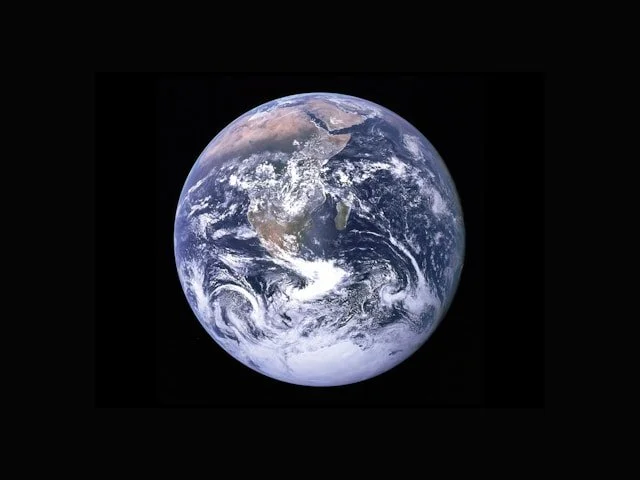
How to Read this Newsletter
Humanity is living through an extraordinary time of transformation. In just over a century, we have accelerated our scientific understanding so profoundly that we can create energy sources which give our species an unprecedented competitive advantage over other life on earth. This has resulted in an explosion in the human population, as well as a quantum leap in our technological prowess.
Yet, the combined forces of energy, population and technology have had the unintended consequences of placing significant pressure on the ecological systems which support life.
It’s all connected.
In these newsletters, InContext will examine what is happening in the world through the following five lenses.
Human Scale and Pressure
How many humans is the system currently carrying—and how is that changing?
Energy and Material Use
What is the system metabolizing to sustain itself?
Ecological and Biological Consequences
What non-human biological systems are being crowded out?
Conflict and War
Where is systemic stress converting into conflict and violence?
Acceleration of Technology
What new technological capabilities recently entered the system?
This newsletter will present high-level data points, along with brief narratives and sources. The goal is to help you, the reader, understand how these multiple forces are interacting with each other, and shaping the world in real time. This newsletter may be a long read. Consider absorbing the information in more than one sitting.
Editor’s Note: the InContext newsletter presented by Restoration Economics is Class 2 content, as described in our AI Disclosure Policy.
Human Scale and Pressure
How many humans is the system currently carrying—and how is that changing?
In 1960, the global human population was estimated at 3 billion people. Here in March of 2026, the current estimate is close to 8.3 billion people. This is an increase of 276% in 66 years.
The human population grew by approximately 69 million people from October 2024 to October 2025, according to the United Nation’s World Population Prospects. As reported by Datareportal, the population growth in the 2020’s is happening at an annual rate of less than 1% per year. This is slower than in the early 1960s, when the population was growing at up to 2.3% per year.
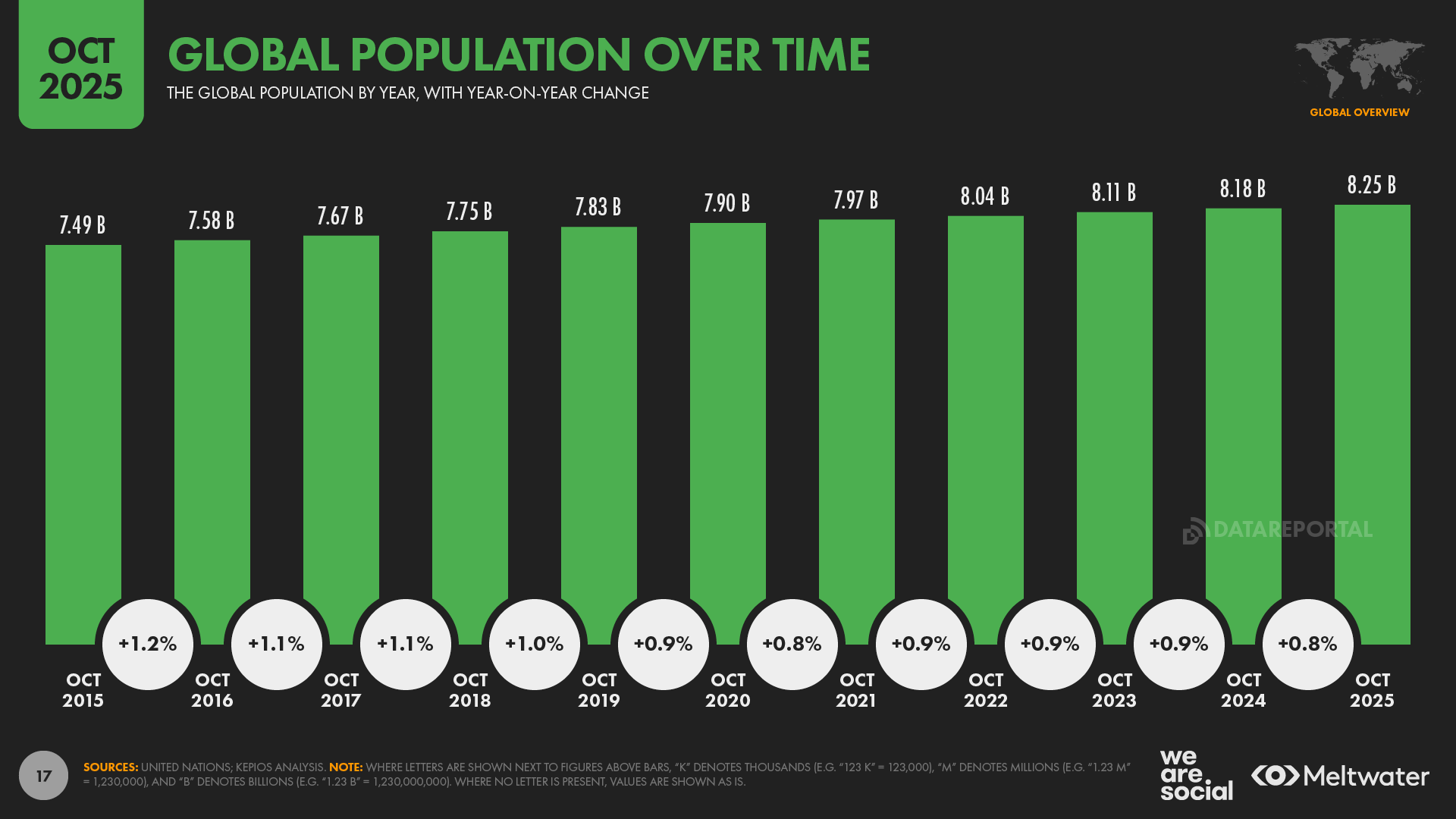
From Datareportal: Digital 2026: global population trends
Inherent in this data is the reality that fertility rates are declining. Some countries see this decline more than others. China’s declining birth rate has been noted recently in the news.
China’s Birth Rate Hits Record Low As Population Continues to Shrink
Still, the net result is that the human population continues to increase every year, although the rate of the increase is slower today than in decades past.
Energy and Material Use
What is the system metabolizing to sustain itself?
Sustaining 8.3 billion people requires continuous use of energy and materials. What does that energy and material use look like today?
As of 2024:
Fossil fuels account for about 80-82% of total energy consumed.
Nuclear accounts for 4-5%.
Renewables account for about 14-16%.
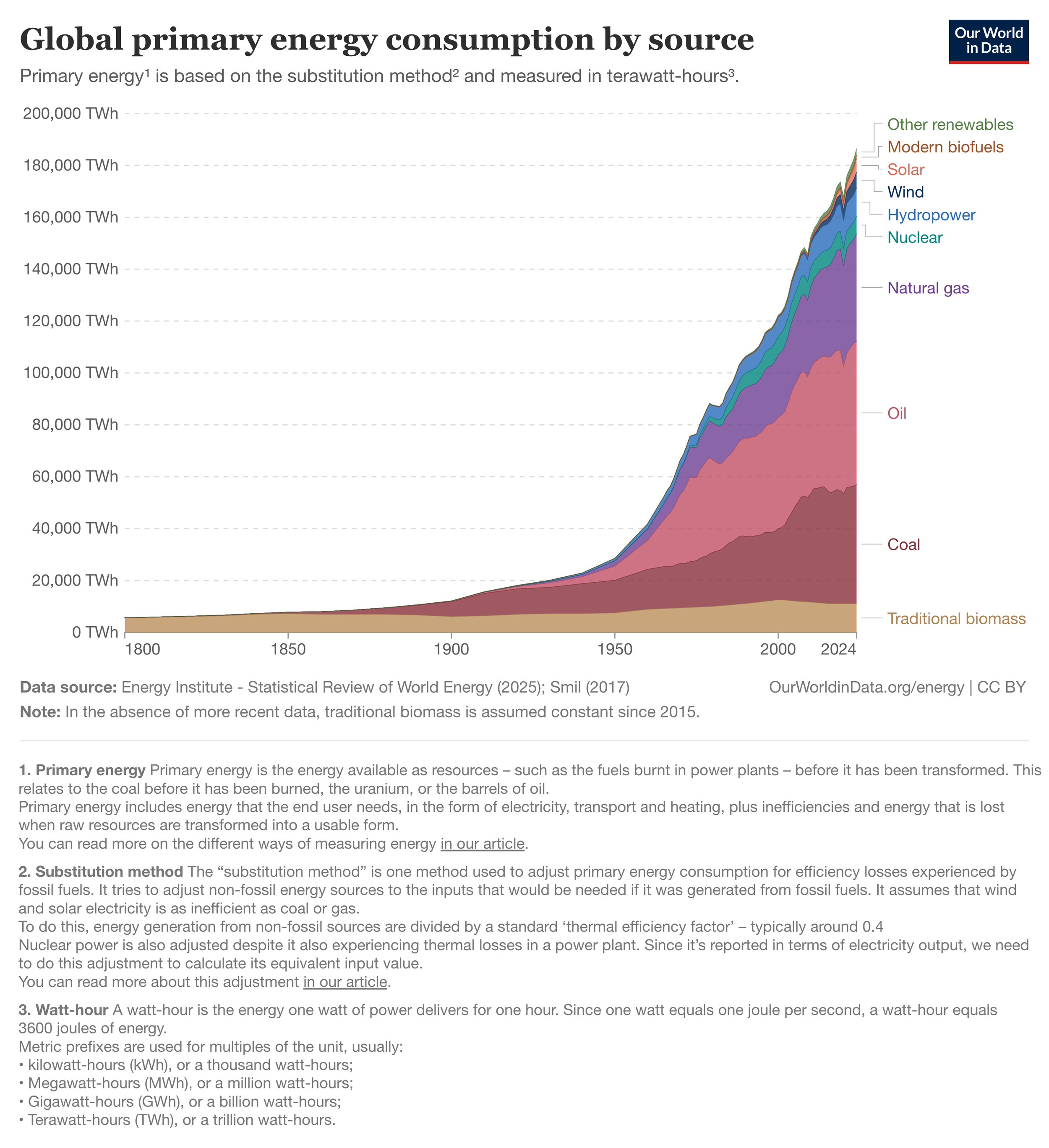
Total terawatt hours of energy consumed continue to grow. The total consumption of energy in 2024 was 186,383 terawatt hours. This is an increase of over 445% compared to 1960, when global energy clocked in at 41,814 terawatt hours.
This down and dirty math is linked to more sophisticated sources from Our World in Data.
Due to the attack on Iran by the United States and Israel at the end of February, the Strait of Hormuz became compromised. This narrow waterway between Iran, the United Arab Emirates and Oman in the Middle East transports about 20% of the world’s oil and 20-25% of the world’s liquified natural gas (LNG) to the global markets. The war continues to create volatility in the price of crude oil. If oil prices reach a sustained threshold of $120 per barrel or higher, it could create a major shock to the global economy.
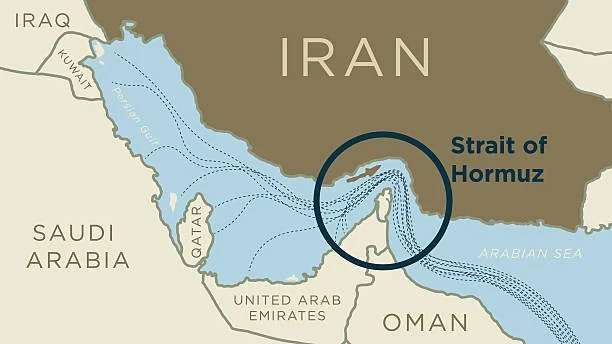
What to watch in the weeks ahead: does oil shipping resume through the Strait of Hormuz? This is dependent on both a de-escalation in military action, and a willingness on the part of insurers to insure the big oil tankers as they take the trip. Another factor in preventing oil prices from rising exorbitantly is if the United States and European governments decide to release oil from their strategic oil reserves. On March 11, 2026, the International Energy Agency announced that it would take such action and release 400 million barrels of oil onto the global market.
International Energy Agency announces largest ever release of reserve oil amid Iran war
On March 16 Japan decided to release 80 million barrels of oil from its own reserves.
Japan begins its largest-ever oil release from strategic reserves
It also appears that oil producers are settling into the idea that this conflict will not resolve quickly. They have begun diverting oil tankers through another route - the African Cape of Good Hope route. This increases the time and cost of oil delivery, but it may help ensure a more consistent flow of oil.
Global trade reroutes to Africa as Hormuz traffic plunges 90%
Attacks are also damaging and shutting down oil and LNG hubs in Iran, Qatar, Saudi Arabia, and Bahrain to date. This situation is fluid and evolving on a day to day basis.

Growing Strategic Importance of Copper
In the 21st century, copper has emerged as a critical metal for digitization and the energy transition. It is essential for power grids, data centers, electric vehicles and renewable power. In time, the demand for copper could squeeze its supply. If you’re curious, here is an interesting article from Business Today that explains the issue.
Lithium and Battery Metals
Lithium has become a key component of electronic and clean energy technologies. The global demand more than doubled between 2020 and 2023. According to the International Energy Agency, demand could grow to 1.3 million tonnes for lithium by 2040. Current mining and refining remains geographically concentrated in China, Australia and Chile, with China holding most of the refining power. It takes years to create a productive lithium mine once a deposit is found.
Transitioning away from fossil fuels means transitioning to other energy sources. These technologies come with their own material demands, geographical restraints, geopolitical pressures and environmental costs.
Ecological and Biological Consequences
What non-human biological systems are being crowded out?
The human population grew from 3 billion to approximately 8.3 billion in 66 years. With all of the extractive technologies deployed to develop energy, food, and materials for this immense human population, it is not surprising that we have witnessed tremendous pressure on the other creatures who share this earth with us.
Yet tracking the ecological consequence of this moment in history is not so simple. It is fair to say that, until human populations began to steeply increase, we did not pay as close attention to our impact on the environment around us.
In 1964, the International Union for the Conservation of Nature created the first Red Book to describe the phenomena of “threatened” species. Over time, this has developed into the Red List of Threatened Species.
This is a relatively new science. Do we even know and understand all the different species on the earth? No - we do not. There is an “estimated” 8-10 million species on planet earth. But scientists have only properly observed and described about 2 million of these.
This estimation comes from biodiversity research published in PLOS Biology (Mora et al., 2011) and summarized in UN biodiversity reports.
The process of tracking the ecological and biological impact first involves identifying and assessing what creatures share the biosphere with humans. Only then, can we attempt to assess whether the species is threatened or not.
According to the IUCN Red List, approximately 900 species are confirmed to have gone extinct since the 1500s, with the majority of those extinctions happening after 1960. This is a floor, not a ceiling, as other species may have gone extinct that we simply do not know about.
Currently, the IUCN Red List lists more than 48,000 additional species that are threatened with extinction, out of the 172,000+ species that IUCN has identified.
We know some of what has been lost. But we may never know the totality of what has been lost.
With this as a baseline, here are a few relevant data points around ecological and biological stress as of March 2026.
IUCN Red List Status Changes (Latest Updates Continuing into 2025-2026)
Multiple amphibian, freshwater fish, and plant species have been reassessed, and considered at higher risk of extinction due to habitat loss, pollution, and climate stress. Large-scale freshwater species are declining across river systems around the world.

Amazon Deforestation
Brazil has focused on cracking down when it comes to illegal clear-cutting of the Amazon Rain Forest. In 2024-2025, the country saw the lowest figure for forest clearing since 2014. The figure is 514 square miles cleared in 2024-2025. 514 square miles is a still a big number, but it is being hailed as an improvement.
The country hopes to continue the trend into next year. The goal of Brazil is to have net zero deforestation by the end of the decade.

Coral Reef Bleaching
This is one of the most concerning ecological markers heading into 2026. Due to warmer than average sea-surface temperatures, corals in the world’s oceans have come under extreme stress. There are fears that 2026 might pose an existential threat to coral reefs.
“Tropical coral reefs cover less than 1% of the seafloor, yet support 25% of all marine species. They are also incredibly vulnerable. Over the past few decades, an estimated 30%-50% have already been lost.
We are approaching a concerning threshold. After record-breaking ocean heatwaves of 2023-24, which saw coral “bleaching” in at least 83 countries, scientists are looking towards 2026 with growing dread.
The question is whether this will be the year a global tipping point is reached for warm-water coral – a point beyond which their fate is sealed, and even the most resilient species can no longer recover.”
2026 May Be The Year Coral Reefs Around The World Finally Collapse
Coral “bleaching” happens when corals experience biological stress from changes in temperature, light or nutrients. Under those conditions, they expel the symbiotic algae living in their tissues. This causes the coral to become completely white, since the algae give them color.
Although bleaching is not synonymous with death, it does leave the coral weak and more susceptible to disease and starvation.
A recent study showed that over half of the corals in the world suffered extreme, life-threatening bleachings over a three year period of 2014-2017. This was named the “Third Global Coral Bleaching Event.” Coral bleaching that began in 2023 is being named the Fourth Global Coral Bleaching Event, which scientists consider even more dangerous.
Over Half of World's Coral Reefs are Bleached; 'Irreversible' Damage Warned: Study
Conflict and War Posture
Where is systemic stress converting into conflict and violence?
With human populations growing, and with increasing demands for energy and materials, we need to remember we live on a finite earth. Different geographical regions hold different elements, minerals, and deposits which provide the raw materials for modern life. Conflicts can develop from population pressure, competition for resources and/or a clash of political and ideological views. Based on the data, these conflicts are increasing in number.
The Institute for Economics and Peace, which publishes a Global Peace Index Report each year, had this to say in its Executive Summary for 2025.
“The 2025 GPI finds that global peacefulness continues to decline and that many of the leading factors that precede major conflicts are higher than they have been since the end of WWII. More countries are increasing their levels of militarisation against the backdrop of rising geopolitical tensions, increasing conflict, the breakup of traditional alliances and rising economic uncertainty.
There are currently 59 active state-based conflicts, the most since the end of WWII and three more than the prior year. Last year, 17 countries recorded over 1,000 conflict deaths. Additionally, the successful resolution of conflicts is lower than at any point in the last 50 years.” (Institute for Economics & Peace. Global Peace Index 2025: Identifying and Measuring the Factors that Drive Peace, Sydney, June 2025. Page 2)
Given the time lag in reporting, it is fair to assume there are around 60 armed conflicts globally today. Not all of these conflicts rise to the level of “war” - which needs 1000 conflict-related deaths to be considered a “war.”
While larger conflict trends are tracked slowly over time, we can monitor ongoing major conflict and war events month to month. Here are a few highlights as of mid March 2026.
US-Israel War with Iran (Major Escalation)
(Note: this summary of the US-Israel war with Iran has been generated through ChatGPT and verified by the author. This section can be considered Class 3 content under our AI Disclosure Policy.)
One of the most significant geopolitical developments has been the escalation of military conflict between the United States, Israel, and Iran. On February 28, the United States and Israel launched coordinated airstrikes on Iranian nuclear facilities, missile infrastructure, and military targets. Iran responded with missile and drone attacks against Israel and against U.S. military assets in the region.
The strikes in Iran reportedly resulted in the death of Iran’s Supreme Leader, 86 year old Ayatollah Ali Khamenei, and other Iranian leaders.
The conflict quickly expanded beyond the initial strikes. Missile exchanges, attacks on regional infrastructure, and maritime disruption in the Persian Gulf have created instability across the Middle East. Shipping and air travel have been disrupted, and energy markets have responded with volatility due to the strategic importance of oil and liquefied natural gas shipments passing through the Strait of Hormuz.
The conflict expanded into Lebanon on March 1–2 when Hezbollah launched rockets and drones into northern Israel in response to the U.S.–Israeli strikes on Iran. Israel retaliated with extensive airstrikes on Hezbollah infrastructure in southern Lebanon and Beirut and deployed forces along the border, with limited ground operations aimed at pushing Hezbollah away from Israeli settlements. The escalation has displaced civilians in southern Lebanon and intensified political tensions inside the country over Hezbollah’s role in the regional war.
Russia-Ukraine War
You can read the full update from the Institute of the Study of War.
(Note: this summary of updates with the Russia-Ukrainian War has been generated through ChatGPT and verified by the author. This section can be considered Class 3 content under our AI Disclosure Policy.)
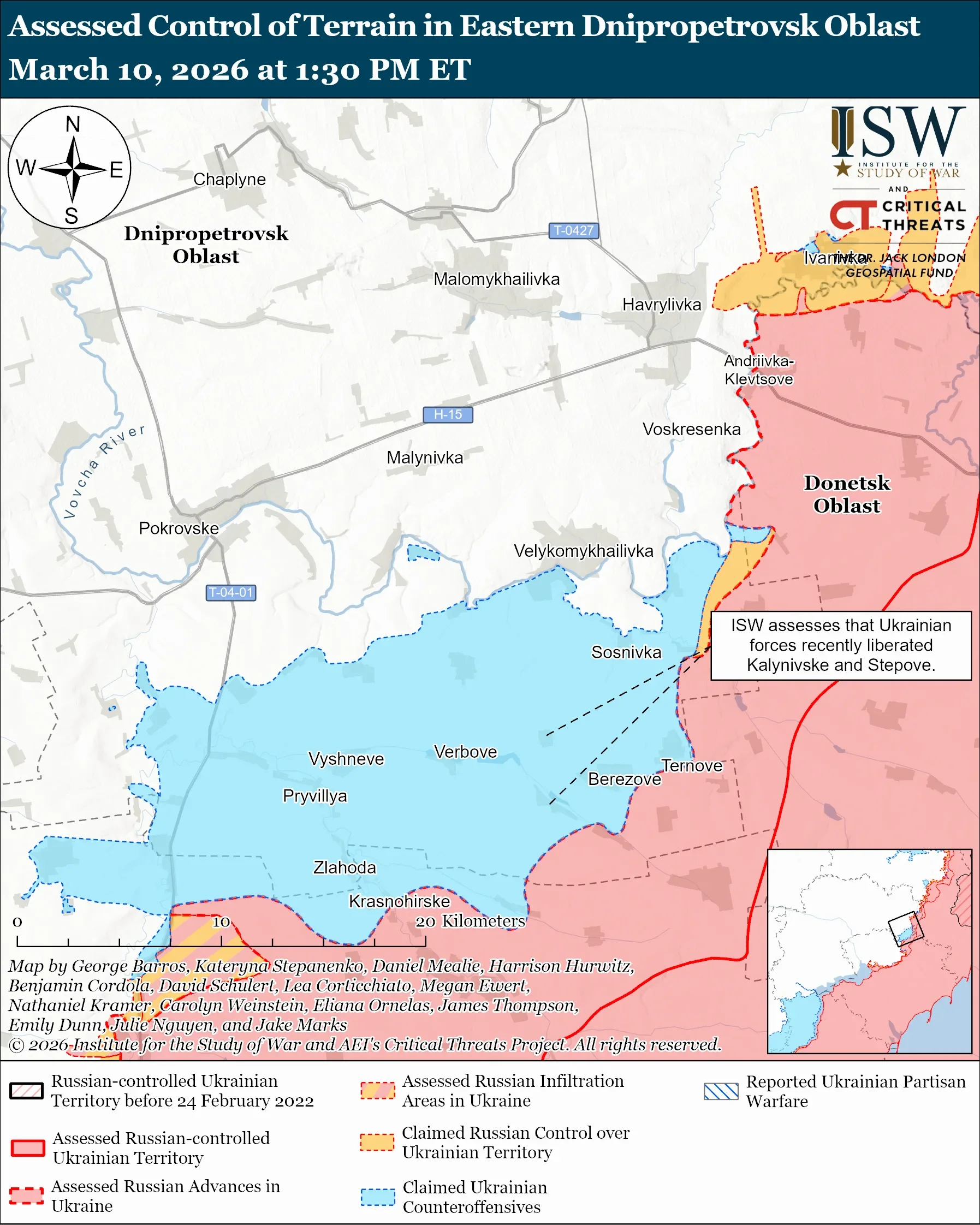
Ukrainian forces have recently regained localized momentum on the battlefield in southern Ukraine. Since late January 2026, Ukrainian counterattacks near the Hulyaipole and Oleksandrivka directions have pushed Russian forces back and reportedly liberated more than 400 square kilometers of territory. These operations appear designed to disrupt Russia’s anticipated spring–summer offensive campaign by forcing Russian commanders to redeploy forces and resources to stabilize vulnerable sectors of the front.
At the same time, technological changes continue to reshape the conflict. Ukrainian forces have expanded their use of first-person-view (FPV) drones and other strike systems to target Russian logistics, communications equipment, and troop movements behind the front lines. Analysts say these drone operations are extending the effective “kill zone” along the front and complicating Russian supply and maneuver operations. Meanwhile, the war continues to impose enormous human costs: Ukrainian officials estimate that Russian forces have suffered more than one million killed or seriously wounded since the start of the full-scale invasion in 2022.
9.2% Increase in Global Military Spending in 2024
According to the Stockholm International Peace Research Institute (SIPRI), global military expenditures reached over 2.7 trillion dollars in 2024. This is the 10th year of consecutive increase in military spending. Over 100 countries around the world increased their military spending. To name a few: Russian military spending rose by 38%. Ukraine’s by 2.9%. Germany’s military spending rose by 28%. Poland’s by 31%. Israel’s military spending rose by 65%. Lebanon’s by 58%. Iran actually saw a drop in military spending of 10% by 2024. Clearly - the current war with the US and Israel is changing that math. Mexico’s increased by 39%. China’s increased by 7%.
You can read more details about this in the following article:
Unprecedented Rise in Global Military Expenditure as European and Middle East Spending Surges
Increases in military spending lay the groundwork for the spread of conflicts in our world.
Acceleration of Technology
What new capabilities entered the system this month?
More humans mean more analytical power, more curiosity, more creative exploration. Technological acceleration is a fascinating, if not defining, feature of our current times. This issue is so significant, there are online media sites dedicated to writing daily about technology developments, their cultural impacts, and the politics and money behind them: Gizmodo and Wired Magazine, for example.
In this section of our newsletter, we highlight a few recent technological advances.
AI Models Continue to Expand Their Capabilities
In March of 2026, OpenAI introduced ChatGPT 5.4. The context window for this version is now 1 million tokens - over twice as large as prior models. This means that ChatGPT can work with much larger source material than in prior releases. The model also has the ability to work directly on your computer with your software and perform work functions on your native files.
You can read more about ChatGPT 5.4 here.
Anthropic Claude Opus 4.6, another Large Language Model (LLM) has also achieved a 1 million token context window.

Electrical Demand for AI Data Centers
Added abilities for LLMs translate to more energy demand. As these models continue gaining capabilities, and as more people use these tools, technology companies will need more energy to operate. The scaling of energy sources for AI data centers continues to generate controversy.
“The future of data centers and their energy needs, as well as the policy decisions made in this realm, will impact U.S. technological competitiveness for decades to come. While overregulation could hinder AI development, insufficient regulation risks grid instability, rising consumer costs, reliance on high-emission energy sources, public backlash, and setbacks to state and corporate climate goals.” - AI, Data Centers, and the U.S. Electric Grid: A Watershed Moment - February 2026. Published by the Harvard Kennedy School Belfer Center for Science and International Affairs.
Human energy use is a key component of the crowding out of other biological systems on the earth. Given that AI data centers have just created a voracious appetite for energy on top of typical human consumption, we can expect to see many of the dynamic geopolitical tensions of our time play out around the development of these energy sources for the AI data centers.
As noted in the above report, public pressure, public policy and regulation will be needed to thoughtfully decide how to address the issue of the energy needs of AI data centers.
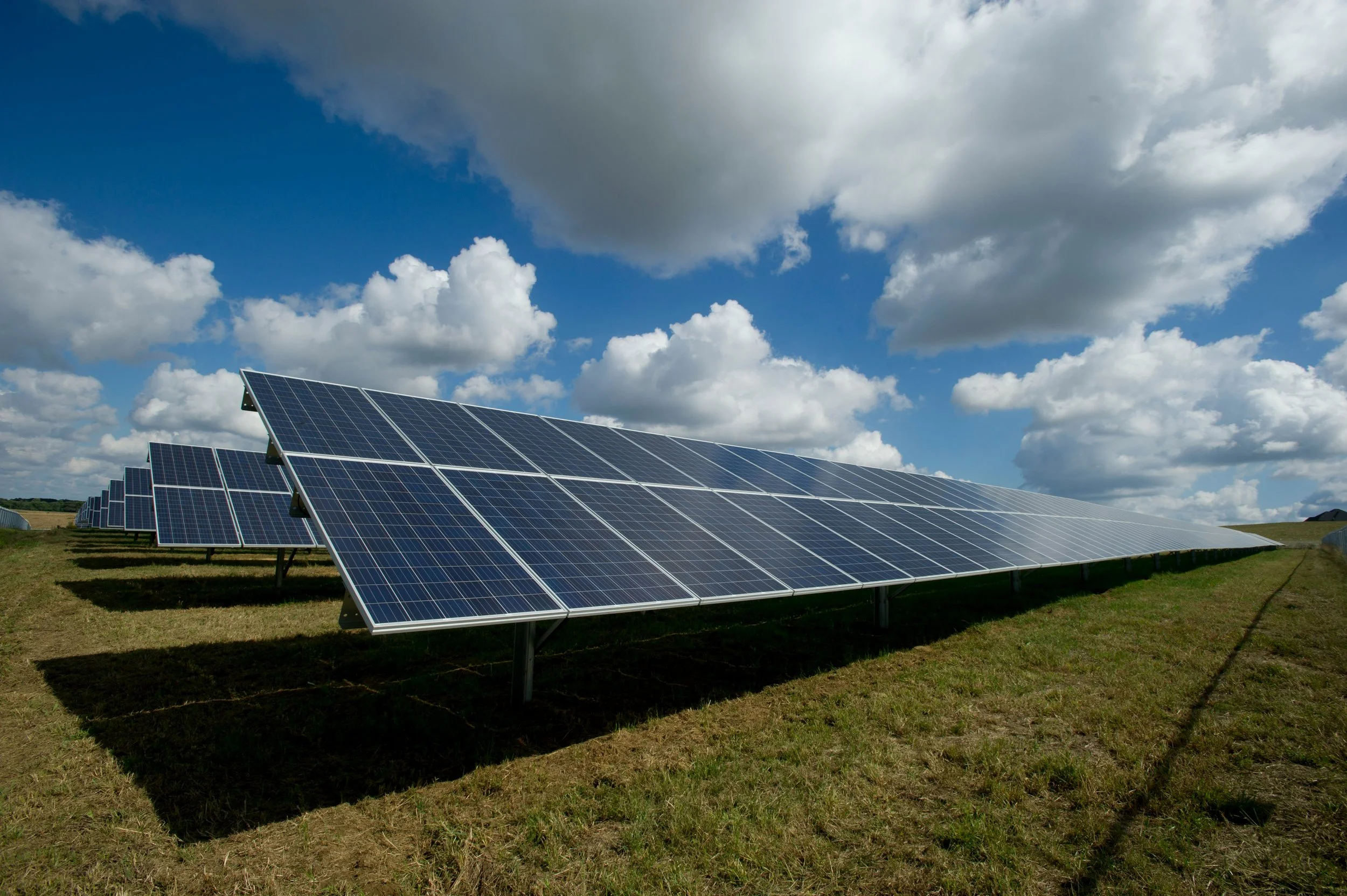
Improved Efficiency and Scalability in Perovskites Solar Cell Manufacturing
In the search for sustainable energy sources, solar technology has been one key alternative to fossil fuels. This month brought a potential innovation in solar cell technology, relating to Perovskite solar cells.
“Perovskites are a family of materials that have shown potential for high performance and low production costs in solar cells. The name “perovskite” comes from their crystal structure. These materials are utilized in other energy technologies, such as fuel cells and catalysts.” U.S. Department of Energy.
Researchers have made improvements that resulted in higher efficiency and a longer life for these solar cells.
For a more scientific description of this advancement, please read the following article. This is still in the research phase. It will take time to bring these innovations to the market.
In Closing
We live in a media landscape that has millions of voices instantly commenting on the latest “thing.” But biological and earthly systems move at a slower rate. Like an iceberg, one cannot sit and watch it move. Yet it does move - and as it moves, it reshapes its surroundings in profound ways.
In this, our first installment of Restoration Economics’ InContext newsletter, we offer a groundwork for a slower moving analysis of the key forces operating in our time.
Human beings do not like to think of ourselves as the result of larger systems. Yet we do come from and are affected by these systems. Tracking these systems over time can give us insight into what possibilities exist - personally, economically and politically - to help us stay in balance with our rapidly changing world.
Until next time.
Yours in Consciousness,
Ek Ong Kaar K. Michaud

InContext is our monthly newsletter, where we discuss recent world events through the Restoration Economics lens. If you have feedback or would like this newsletter sent directly to your email, please click here.
Credits:
Photo by NASA on Unsplash
Photo by ERIK SETH on Unsplash
Photo by Daniel Carmona on Unsplash
Photo by Hiroko Yoshii on Unsplash
Photo by Joshua Sortino on Unsplash
Photo by American Public Power Association on Unsplash